Human life has often been explored as a journey shaped by purpose, action, and understanding. Within this framework, moksha is recognised as the ultimate goal, representing liberation from cycles of attachment and limitation. Rooted in Hindu philosophical traditions, this concept reflects a deeper search for lasting freedom and inner clarity. Rather than being distant or abstract, moksha is understood as a state that can be gradually approached through awareness, discipline, and alignment with one’s true nature.
Moksha in a Philosophical Context
Moksha is described as liberation from the cycle of birth and rebirth, often referred to as Samsara. This cycle is believed to be influenced by karma, where actions shape future experiences. Liberation is therefore seen as freedom from this continuous cycle, allowing the individual to transcend limitations of the physical and mental realms.
Clarity is central to this understanding. When ignorance about the self is reduced, a deeper awareness is said to emerge. This awareness allows the individual to recognise a distinction between the temporary and the eternal. Moksha is not framed as an external achievement but as an internal realisation, where one’s true nature is understood beyond changing circumstances.
The Role of Karma and Samsara
Karma and Samsara are closely connected to the concept of liberation. Actions, intentions, and their consequences are believed to bind individuals to ongoing cycles of experience. These cycles are not limited to physical existence but are also reflected in patterns of thought and behaviour.
Liberation is approached by reducing attachment to the outcomes of actions. When actions are performed with awareness and without expectation, their binding effect is believed to lessen. Over time, this reduces the accumulation of karmic impressions. Getting to know this relationship helps shift focus from external results to internal balance. Through this process, the path towards moksha is gradually shaped by mindful living rather than reactive behaviour.
Paths Leading Towards Liberation
Different approaches have been outlined to guide individuals towards moksha. These paths are not mutually exclusive and may often be practised together, depending on personal inclination and understanding. Jnana yoga focuses on knowledge and self-inquiry. Through reflection and study, the nature of the self is explored. Bhakti yoga emphasises devotion, where surrender and emotional connection are central. Karma yoga is centred on action performed without attachment, encouraging balance through responsibility and detachment.
Each path offers a structured way to refine awareness. Rather than prescribing a single method, flexibility is maintained, allowing individuals to engage in a way that aligns with their disposition. This adaptability supports gradual progress without imposing rigidity.
The Nature of the Self and Realisation
A key aspect of moksha lies in understanding the nature of the self. In many Hindu philosophical perspectives, the self is seen as distinct from the body and mind. While the body changes and the mind fluctuates, the true self is described as constant and unchanging.
Realisation involves recognising this distinction. When identification with temporary aspects is reduced, a sense of stability and clarity may develop. This does not require withdrawal from daily life but encourages a shift in perception. Through consistent awareness, attachment to external identities may lessen. This gradual shift supports a deeper understanding of existence, where the self is no longer defined by external conditions.
Detachment and Inner Freedom
Detachment is often associated with the path to moksha, but it is not defined as withdrawal or indifference. Instead, it is understood as maintaining balance while engaging with life. Attachments are believed to arise from identification with outcomes, relationships, and possessions. When these attachments become excessive, they may lead to imbalance or dissatisfaction. By observing these tendencies, a more measured approach can be developed.
Inner freedom emerges when dependence on external validation is reduced. This allows actions to be guided by clarity rather than compulsion. Over time, this balanced engagement contributes to a more stable and grounded state of being.
Ethical Living and Discipline
Ethical conduct is considered an essential aspect of progressing towards moksha. Values such as truthfulness, non-violence, and self-discipline are emphasised as foundational principles. These practices are not viewed as restrictions but as tools to create internal harmony. Discipline supports consistency in thought and action. When behaviour aligns with these principles, mental disturbances may be reduced. This creates a more stable environment for self-reflection and awareness.
Rather than being enforced, ethical living is encouraged through understanding its impact on overall well-being. As clarity develops, these practices are naturally integrated into daily life.
Meditation and Self-Awareness
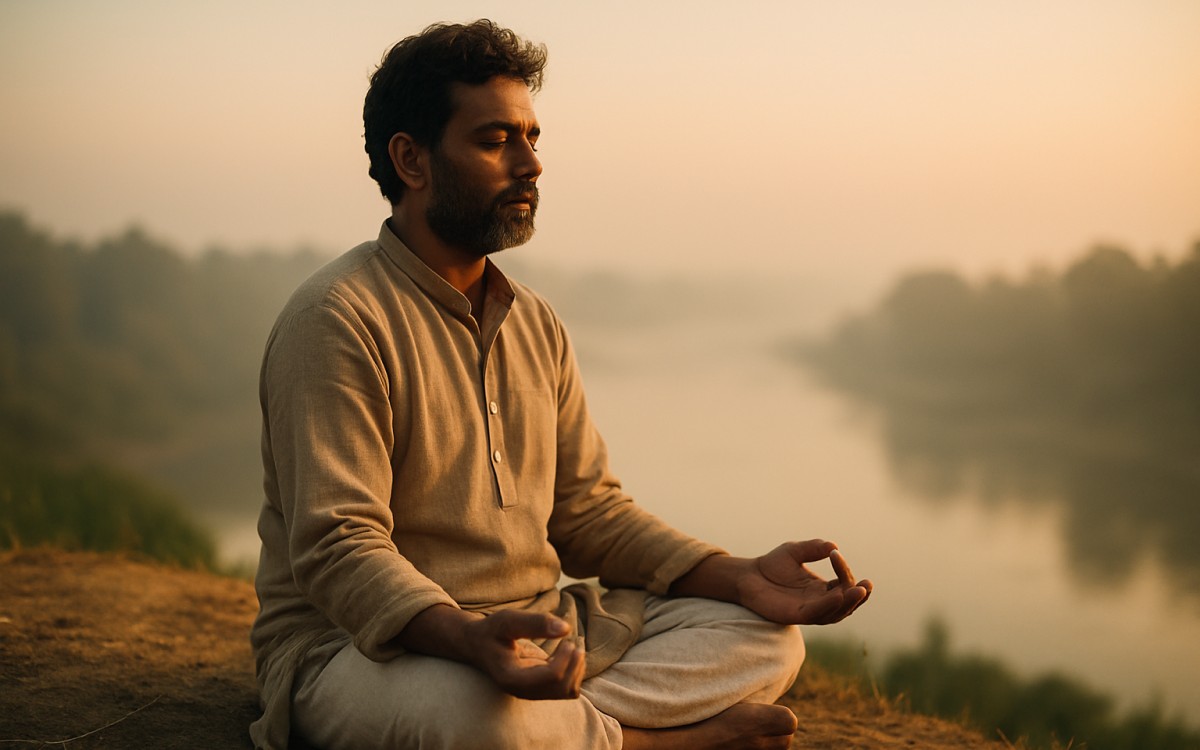
Meditation is often highlighted as a method to deepen awareness and support the journey towards moksha. Through regular practice, attention is directed inward, allowing thoughts and patterns to be observed without immediate reaction.
This process helps in identifying habitual tendencies that contribute to attachment or imbalance. As observation becomes more refined, the mind may gradually settle. This creates space for deeper insight into the nature of the self. Self-awareness extends beyond formal practice. It is carried into daily activities, where actions and responses are observed with greater clarity. This continuity strengthens the overall process of inner development.
Moksha in Everyday Living
Although moksha is described as a final state of liberation, its principles are reflected in everyday life. Small shifts in awareness, behaviour, and perception contribute to this broader goal. Moments of clarity, reduced attachment, and balanced responses are considered expressions of this process. Rather than being distant or unattainable, moksha is approached through consistent and mindful living.
Daily interactions, responsibilities, and challenges become opportunities for refinement. Through these experiences, understanding deepens, and the path towards liberation becomes more integrated with ordinary life.
Lastly, it is a State of Inner Liberation
Moksha represents a state where limitations shaped by ignorance and attachment are no longer dominant. It is understood as freedom that arises from within, rather than being dependent on external circumstances. Rooted in Hindu philosophical thought, this concept offers a structured yet adaptable framework for self-understanding. Through awareness, ethical living, and balanced engagement, the journey towards liberation is gradually shaped.
By aligning actions with clarity and reducing attachment, a steady sense of inner freedom may be experienced. This approach presents moksha not as an abstract idea but as a practical and evolving process within the human experience.