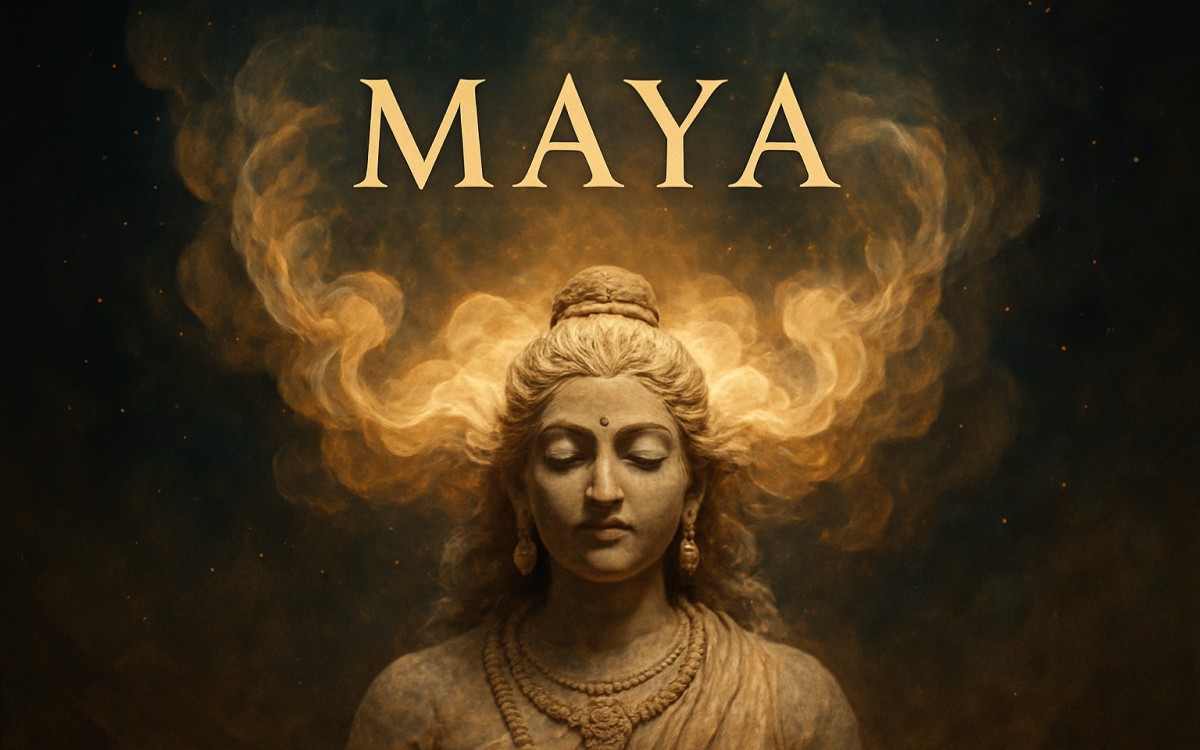
The concept of maya in Hindu philosophy begins with a profound understanding of reality’s dual nature. Maya represents the cosmic illusion that veils the eternal truth of Brahman, the ultimate consciousness. It creates the appearance of a diverse, material world while concealing non-dual oneness. Rooted in Vedic texts, Maya develops into a concept that explains why the transient seems permanent, prompting seekers toward discernment. Transcending it through knowledge leads to liberation, fostering clarity amid life’s play.
Etymology and Core Meaning
The term Maya derives from the Sanskrit root “ma,” meaning “to measure,” “to form,” or “to build.” In early Vedic literature, Māyā refers not to illusion but to extraordinary power or skill, especially the divine capacity of gods to manifest and shape phenomena.
In later texts, particularly the Upaniṣads, the meaning evolves. Maya comes to signify the principle that makes the empirical world appear real while veiling the underlying unity of Brahman. The Svetasvatara Upanishad, for example, describes God as the wielder of Maya (mayin), whose power manifests the world of multiplicity.
Philosophically, Maya is described as neither absolutely real nor absolutely unreal, but anirvachanīya, indefinable. It is often illustrated through the classic analogy of a rope mistaken for a snake in dim light: the misperception is experientially real but ultimately false.
Maya in Advaita Vedanta
Adi Shankaracharya places Maya at the heart of Advaita Vedanta, a school of thought meaning “non-dual” philosophy, where only one ultimate reality exists. He teaches that the world appears very real and lively to our senses, yet it remains illusory, like a changing appearance called vivarta. Brahman, the eternal, unchanging pure consciousness, stands as the sole true existence. Maya acts like a magical power that overlays temporary names, shapes, and objects onto Brahman, much like waves rise and fall on the surface of a vast ocean without altering the water itself.
A common personal ignorance, known as avidya (meaning “not knowing” or lack of true wisdom) mirrors this grand cosmic Maya. Just as a person mistakes a rope for a snake in poor light due to ignorance, individuals see separation and diversity where only unity prevails.
Consider the simple analogy of a clay pot: the pot seems solid and real, but its true essence comes entirely from clay. When broken, the pot vanishes, leaving only clay behind. In the same way, the entire universe, with all its forms, dissolves back into Brahman when true enlightenment dawns, revealing no separate existence.
Maya keeps individual souls, called jivas (meaning living beings with a sense of “I”) trapped through everyday pulls like desires (wants that never satisfy), egos (false sense of self-importance), and karma (actions and their accumulated results). This trap creates samsara, the endless wheel of birth, death, and rebirth, where one keeps wandering without peace.
In his deep explanations of the Brahma Sutras (ancient texts compiling core Vedanta teachings) Shankaracharya describes Maya as beginningless, with no starting point in time, and upheld purely by Brahman’s effortless will. Freedom comes through viveka, the clear power of discrimination, which separates the truly real (satya, eternal and unchanging) from the apparently unreal (mithya, seemingly true but temporary). This insight leads to jnana, direct spiritual knowledge that shatters the veil of Maya like sunlight dispelling morning mist.
Perspectives Across Schools
Samkhya
Samkhya does not interpret the world as an illusion. Instead, it proposes a dualistic realism:
- Prakrti (material nature) is real and evolves into the universe.
- Purusa (pure consciousness) is also real and remains a detached witness.
The theory of the three gunas, sattva, rajas, and tamas originates here. Unlike Advaita, Samkhya does not posit Maya as an illusion-making principle. Liberation comes from discriminating between Purusa and Prakrti, not from seeing the world as illusory.
Visistadvaita Vedanta
In the philosophy of Ramanuja, known as Visistadvaita (“qualified non-dualism”), the world is real and meaningful, not illusory. While the term Maya may still be used, it does not denote illusion in the Advaita sense. Instead,
- The universe is a real manifestation of Brahman
- Individual souls and matter are modes (prakara) of God
Devotion (bhakti) becomes the primary path, with the world serving as a genuine arena for spiritual growth and relationship with the divine, especially Vishnu.
Dvaita Vedanta
The dualist school founded by Madhva maintains that distinctions in reality are eternal and real. Madhva’s doctrine of five real differences (panca-bheda) includes:
- God and soul
- God and matter
- One soul and another
- Soul and matter
- One material thing and another
In this system, the world is fully real, not a projection of Maya in the Advaita sense. Maya may be understood as God’s power, but it does not imply illusion. Liberation is attained through devotion and God’s grace, not through negating the world’s reality.
Bhakti Traditions
In devotional traditions, My is often described poetically as a divine power that enchants and binds the soul, yet ultimately serves a spiritual purpose. Texts such as the Narada Bhakti Sutras emphasize loving devotion as the path beyond worldly attachment. Maya, in this context, represents the distractions and attachments that must be overcome through surrender (prapatti) and divine love.
Role in Spiritual Practice
Maya naturally inspires sadhana, which is a consistent spiritual discipline and daily practice, by revealing how all worldly things constantly change and fade away, urging seekers to look beyond surface appearances. This awareness motivates focused effort toward lasting truth.
Jnana yoga, the path of wisdom, uses simple self-inquiry questions like “Who am I?” to break down ego-driven illusions created by Maya. It peels away false ideas of separateness, layer by layer, until only pure awareness remains.
Ancient scriptures strongly recommend studying Vedanta, the core Hindu philosophical texts, under the guidance of an experienced guru. This personal teaching ensures clear understanding and direct realization of the truth hidden by Maya.
Karma yoga counters Maya’s hold through selfless action, where one performs duties without attachment to results. This purifies the mind over time, reducing desires and freeing it from illusionary bonds.
Bhakti yoga melts away Maya entirely through heartfelt devotion. Practitioners see the divine presence shining in every person, object, and situation, transforming the illusory world into a playground of love.
Raja yoga employs meditation to calm the mind’s constant fluctuations, known as chitta vritti or restless thoughts and emotions. By stilling these waves, it uncovers the unchanging unity beneath Maya’s veil.
Rituals called upasana, which are devotional forms of worship like chanting or offerings, call upon divine grace to gradually thin Maya’s covering, making truth more accessible.
Analogies Illustrating Maya
The rope-snake example clarifies how fear arises from misperception, vanishing with light (knowledge). Similarly, Maya breeds attachment until wisdom dawns.
Dreams offer another example. They are vivid while asleep, unreal upon waking. The world persists like a dream until Brahman-knowledge awakens the soul.
Similarly, mirage water shimmers in deserts, deceiving thirst. Meanwhile, Maya tantalizes the senses with fleeting pleasures. These metaphors, drawn from Upanishads, aid comprehension without literalism, guiding intellect beyond the senses.
Enduring Philosophical Impact
The concept of Maya explains the root of suffering without nihilism, while affirming purposeful existence. Modern thinkers like Swami Vivekananda adapted it for global audiences, linking it to what modern psychology calls “reality testing.”
In education, it inspires critical inquiry beyond appearances. Art and poetry evoke its mystery, as in Kalidasa’s works. Communities uphold it through guru-shishya lineages, ensuring timeless relevance.
Ultimately, Maya serves realization: by veiling, it provokes the quest unveiling Brahman. This dynamic underscores Hinduism’s optimistic soteriology, ignorance yields to eternal truth through persistent seeking.